
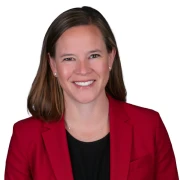

South Dakota farmer and rancher Christine Hamilton doesn’t point to one person or one particular event that has brought Christiansen Land and Cattle (CLC) success. But rather, she credits systems for outfitting her team to be prepared to seize each opportunity.
“Everything is a system with lots of moving parts. We try to find leverage in the system to make things better. I believe in choosing the right people and empowering them because talented people appreciate the opportunity to make the daily decisions to move forward on a task,” Hamilton says.
Rooted in her on-farm upbringing alongside a strong entrepreneurial streak passed from generation to generation, Hamilton constantly surveys the landscape and prepares her farm and ranch for its next plateau of success. Due to her achievements in farm management and excellence in leadership, Christiansen Land and Cattle was recognized as the 2024 Top Producer of the Year, an award sponsored by BASF, Case IH and Rabo AgriFinance.
With an unassuming pursuit of excellence, Hamilton leads the team driven by the pursuit of doing things in a better way but not for the sake of being the best.
While she has taken on a number of leadership roles on and off the farm, Hamilton says some of her greatest sense of achievement comes from leading from the background and not being the one in front. In that way, she’s a bit of a reluctant Top Producer of the Year — instead she wants the spotlight on what the team has achieved together.
Today, the core team includes her husband Eddie Hamilton; Shawn Reis, livestock manager; Matt Huizenga, crops manager; and Christie Rasmussen, accounting manager.
“Personally, I’ve learned I don’t have to have a big family in the business in order to have a work family,” she says. “Our team effort is the result of values created by the work family, striving for excellence and acting with integrity. They show up every day and do the work to make us successful; they aim for the fences and they value the process of improving.”
She says there is an important detail in the success at CLC — it’s not the job that is done but rather how that job is done.
“Each of our decision time frames is straight forward — planting, weed control, harvesting, purchasing. When a team has the latitude within those decisions to do it their way, the best way, it’s more fulfilling,” she says.
As leader, she says the greatest achievement is in the relationships among the team and the extended relationships out into the community. For her role, she aims to be an enabler of such success. Hamilton has offered her time as a mentor and encourages her team to step up to expand their own opportunities as well.
“We tend to think of businesses as task oriented,” she says. “People would be surprised to learn how much time I spend talking with other people.”

Journey Back Home
“I always knew the business was larger than any one person,” she says.
Hamilton has had her own trajectory from learning tasks to being given responsibility to taking on stewardship. As a child, she worked alongside her parents and at 8 years old would help by pushing the button to start the leg at the grain elevator. Then she’d ride on horseback with her father twice a day to sort and check cows. At the age of 21, her parents gifted her some property to manage.
Hamilton left the farm first to attend boarding school for high school. She stayed on the East Coast to complete her degree in philosophy from Smith College, which was then followed up with an MBA focused on entrepreneurship from the University of Arizona. After her father passed away, and when her mother needed more hands-on help managing the business, she returned 20 years later full time. As their only child, Hamilton was the sole heir after her mother’s passing in 2001, which began an eight-year process of settling the estate in courts.
“The agricultural land we owned had appreciated significantly during the time my parents had owned it, which resulted in estate tax challenges,” Hamilton says. “It was imperative we find a way to assimilate the estate taxes in order to continue the business. Among other tools, the 6166 tax provision was used to spread out the payments.”
She also worked with a team to direct efforts to sell, buy and therefore rearrange land holdings better suited for the operation.
“After my mother passed away, my immediate goals for the farm and ranch were personal,” Hamilton says. “It was about succeeding with the transition in management and ownership from my mother to me, one generation to the next. I was afraid of failure — and probably success, too.”
She says the duration and intensity of this series of events began to intertwine her personal and work identities.
“From 1993 onward, the farm and ranch became a core part of my work and identity, as those of us who are in agriculture as a lifestyle business know all too well,” she says. “My goals for the farm and ranch evolved, as well. I began to see that the farm and ranch continuity depended on more than just me.”

Key Performance Metrics
With the farm and ranch structure ironed out, Hamilton set to work to refine its operation and optimize its performance.
When Hamilton met her future husband, he was serving on the Farm Financial Standards Council (FFSC), and this organization not only was a gathering of bankers, accountants, academia and consultants but was also a key driver to bring activity-based accounting guidelines for production agriculture.
To build a firm foundation of understanding the business of the farm, Hamilton brought in Steve Hofing of Centrec, who became a valued team member and mentor.
“Centrec has been a part of the management team since 1999, acting as our CFO and performing many tasks from risk analysis, assisting in capital purchases, to modeling various scenarios and other services,” Hamilton says.
CLC became an early adopter of activity-based accounting, a practice they continue to expand on the farm today in the decision-making process.
“We collaborated with the software company Centerpoint, now owned by Red Wing, and we have incorporated it into the way we operate and measure our results,” she says. “We have developed cost and activity centers with monthly meetings with managers to know our direct costs. We farm on the land we enjoy the appreciation of, but the challenge is to get returns on the operation.”

A Pioneer Spirit
With the processes in place to ensure CLC performance tracking and reaching goals, Hamilton has been able to turn her attention to interests off the farm.
Her entrepreneurial spirit can not be tamped down. It could be a credit to a lineage of strong female business owners going back to her grandmother who took on ownership of a general store in the wake of her own brother’s murder by cattle rustlers.
Any stumblings have stoked the fire in her to continue to try to help build something else in a better way. Hamilton shares an example of a seed treatment business she invested in and mortgaged part of her farm holdings to become involved.
“I clearly remember getting to the end of the funds available and not being any closer in any way to pay them back — I had a pit in my stomach about wasting that money,” she says. “It motivated me to get my MBA.”
While she says it might have been her biggest failure in business, it refocused her efforts to become a better entrepreneur. She went on to start four companies: a gourmet meat store, a hay production company, a dairy development startup and a wholesale meat company.
The wholesale meat company is still in operation today: Dakota Packing, Inc., based in Las Vegas.
Hamilton believes diversification is a way to spread risk, grow the whole business and take lessons learned from one area and be able to apply them to another.
She helped start South Dakota Ag Producer Ventures, which was an investment entity for producers to invest in startup projects.
“Diversification definitely brings something to the table — ag asset portfolios can be improved with some diversification,” she says. “My husband, Eddie, and I also have additional business interests.”
As a couple, the Hamiltons helped start SAB Bio, a publicly traded biotech company based in South Dakota. Its technology aims to address infectious diseases, diabetes and some oncology targets by creating human polyclonal antibodies in bovine blood using genetic manipulation.
“We’re fortunate to be able to build on the foundation of Christiansen Land and Cattle to explore innovation in biotech and in a wholesale beef business in Las Vegas,” she says. “Several boards we serve on provide a window into innovations and the challenges of additional businesses and nonprofits. We find that diverse interests inform our values and enable us to gain insights into our own business.”
Hamilton currently serves on a second board for a publicly traded company, Titan Machinery, the largest Case IH dealership network. She currently sits on the boards of the Farm Foundation and Padlock Ranch Board. In the past, she’s served on the board for South Dakota State University Foundation, Federal Reserve Bank of the Ninth District, and the South Dakota State Game, Fish and Parks Department Commission.
In The Community
One of the business goals for Christine Hamilton is for Christiansen Land and Cattle to be engaged in its community. As such, CLC supports several local area food banks and volunteer fire departments, along with school fundraisers.
“We have also asked each of our CLC team to recommend a local nonprofit, and we have donated to the chosen organizations in their individual names,” Hamilton says.
In 2001, Hamilton created a 501(c)(3) organization. Named for her family last names: the Matson Halverson Christiansen Hamilton Foundation focuses on creating opportunities and supporting economic development and community vitality in rural South Dakota. The first initiative supported non-traditional students as they pursued their RN degrees.
“The thinking was that healthcare is an economic driver in rural areas, and local residents who want to pursue additional education can have the choice to pursue nursing,” Hamilton says. “That choice will enable them to work locally and also elevates the quality of opportunities in the area.”

Continuous Improvement
With her various roles on and off the farm, no week is the same as the next. However, her intentionality in helping her team always remains the same.
“My goals now for CLC are around how CLC can be an example of thoughtful management that contributes positively to the people who work here, the soil/land health and the community, all while being a solid business with reasonable and consistent returns,” she says.
In 2015, she started the process to develop a sustainability management plan, which took a full look at the business with agronomy and livestock management consultants.
“Through a series of annual meetings that involve the entire management team, we have created a living document that represents the goals and considerations of all the stakeholders of the business,” she says. “This includes the community perspective and thinking about how CLC gives back to the community.”
The team just completed its meeting for 2024, but they don’t call it the sustainability management plan any more — now it’s the continuous improvement plan.
“Of course, there has to be sustainability in everything,” Hamilton contends. “Continuous improvement says it better.”
The meeting includes all business division managers as well as Ag To Go, which are the farm’s agronomic consultants. The meeting lasts about a day and a half, and they go over areas of improvement for the next year. As such, 2025’s list includes: riparian buffers, tree plantings, nutrient management inefficiencies, and soil erosion and control programs.
Hamilton says the biggest motivator for her in business is seeking out the potential for continuous improvement — it helps serve her natural sense of curiosity.
“What we’ve built and how we’ve found success have been offshoots of curiosity and momentum,” she says.
No one knows better than you that the future of your farm depends on balancing practices and profits that sustain your land, resources and family. The stakes are evolving based on weather patterns, technology, market demand and more. What actions are you taking to remain resilient?





