

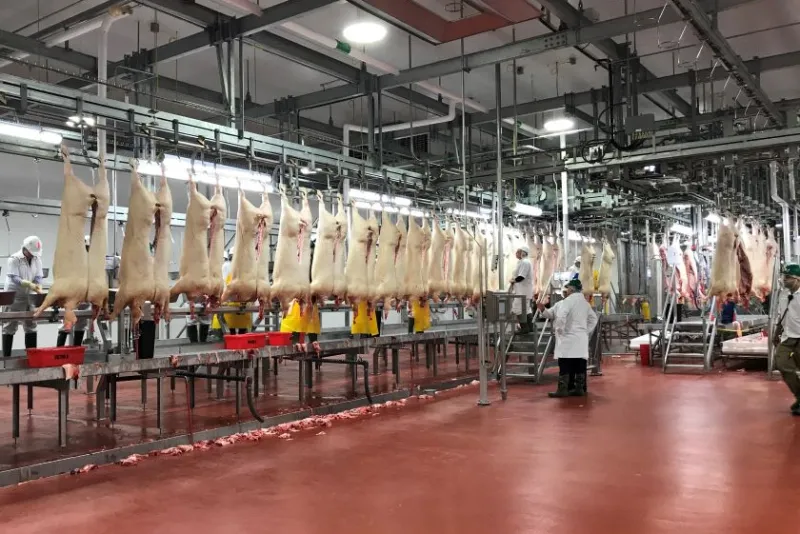
Conflicting reports over the H-2B visa program are raising questions. A new report from the Economic Policy Institute (EPI) claims the H-2B visa program has ‘ballooned without being fixed and expanding it to year-round jobs like meatpacking would lower wages and revenue.’
The H-2B program allows U.S. employers or U.S. agents who meet specific regulatory requirements to bring foreign nationals to the U.S. to fill temporary nonagricultural jobs. Read more about the H-2B visa program here. Agricultural work falls under the H-2A visa program, which is specifically for temporary and seasonal agricultural labor, while the H-2B program is for temporary, non-agricultural jobs in sectors like landscaping, meat processing, and construction.
According to the United Food and Commercial Workers International Union (UFCW), in 2024, there were nearly 170,000 H-2B workers employed in the U.S. – a record high. This is more than 2.5 times the size of the original limit of 66,000 set by law.
Stuart Appelbaum, president of the Retail, Wholesale and Department Store Union (RWDSU), which represents over 15,000 poultry workers at facilities across the southern U.S., as well as meatpacking and processing workers in other parts of the country, says, “The RWDSU strongly opposes expansion of the H-2B visa program into poultry processing and meatpacking. As the recent EPI report makes clear, this program fuels wage suppression and exploitation, putting workers in precarious, insecure jobs.”
The UFCW represents 1.2 million essential workers in grocery, meatpacking, food processing, retail and other essential industries, says the report demonstrates that the H-2B system has become ‘deeply flawed’ and has resulted in depressed wages and other workforce issues.
“As the union representing thousands of meatpacking workers across the country, the findings in EPI’s report are alarming,” says Mark Lauritsen, director of the UFCW’s Food Processing, Packing and Manufacturing Division. “Expanding the use of the H-2B program in the meatpacking industry would drive down wages and working conditions in a sector that provides good, solid jobs in communities across the country, particularly in rural areas.”
The Federation of Employers and Workers of America (FEWA) says the landscaping industry accounts for almost 40% of certified H-2B seasonal workers, on average. The industries that account for the second, third, and fourth most certified H-2B are hotels and motels (8.67%), support activities for forestry (6.3%), and seafood product preparation and packaging (5.65%).
The H-2B Workforce Coalition, an effort aimed at protecting American workers through a stable and reliable seasonal workforce, released a comprehensive economic analysis that explores the impacts of the H-2B Visa Program.
Completed by Edgewater Economics, this study argues the H-2B program has not had a detrimental effect on jobs and the salaries of U.S. workers — it has increased wages and supported the labor force.
“Traditionally, the H-2B program has allowed businesses to hire foreign national guest workers for seasonal jobs when they are unable to identify and hire domestic workers for these positions,” FEWA wrote. “Through this new study, the program has found no evidence of the increase of H-2B Visas issues and a negative impact on the U.S. workforce’s employment and wages.”
Meat Packers Respond
Because of the temporary nature of the H-2B visa, Sarah Little, vice president of communications for the Meat Institute, says H-2B visas are often not used by meatpacking workers.
“The meat and poultry industry, like many others, needs a long-term, stable and legal workforce,” Little says. “Programs of a temporary nature do not meet the needs of our members and are not widely used.”
The Meat Institute is a trade association representing companies that process and supply meat and poultry products in North America, including packers, processors and their suppliers.
“We will continue to work with the Trump Administration and Congress on solutions to ensure our members can produce the food Americans need and that keeps our farmers and ranchers in business,” Little says.




