
Trade

The European Union will provide preferential market access for pork, has committed to streamlining requirements for U.S. pork sanitary certificates, and intends to address other non-tariff barriers affecting agricultural trade.

Removing all non-tariff barriers would open the doors for U.S. beef and pork demand in Indonesia.
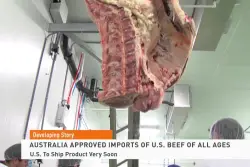
The Trump administration announces trade breakthroughs giving U.S. beef producers greater access to Australia, Japan and South Korea.

On Saturday, President Trump threatened to impose 30% tariffs on Mexico and the European Union starting on August 1. The announcement came after a string of new tariff threats last week.

Secretary Rollins takes decisive action and shuts down cattle, bison and equine trade due to further northward spread of the devastating pest in Mexico.

The deal, according to President Trump, allows the U.S. “total access” to Vietnam’s markets with a zero tariff on U.S. products exported to Vietnam.

Following a New World screwworm assessment by USDA staff in Mexico and ongoing conversations between Secretary Rollins and the Mexican Secretary of Agriculture, USDA will start reopening the ports for cattle, bison and equine.

Two studies illuminate food prices for the holiday barbecue season.

USDA Secretary Brooke Rollins was questioned by several House Ag Committee members about USDA’s cuts, including the impact of the 6,000 DOGE firings at the agency, that were later reinstated by the court.

According to the latest USDA data released from the U.S. Meat Export Federation, beef exports to China dropped 70% in April and pork exports fell 35%. With trade talks ongoing, there is optimism for the remainder of the year.

A federal court ruled Wednesday that an emergency law does not provide President Trump with unilateral authority to impose tariffs on nearly every country. The interruption was short-lived after a federal appeals court granted the Trump administration’s request to temporarily pause a lower-court ruling.

A company’s population is a factor affecting its beef trade. Population and per capita consumption drives total beef consumption.

In parts of Central America, illegal ranching on protected lands has become a front for drug trafficking and money laundering. The ripple effects of this trend now threaten U.S. cattle producers with the resurgence of a deadly livestock pest.

After suspending live cattle imports from Mexico and a trip to the UK to talk trade, the secretary of agriculture looks ahead to domestic affairs and the anticipated May 22 MAHA report.

NCBA applauds Secretary of Agriculture Brooke Rollins’ aggressive efforts to suspend Mexican cattle, horse and bison imports, saying Mexico’s corruption and mismanagement has caused the pest to spread closer to the U.S.

Due to the northward spread of New World Screwworm, a month-by-month suspension is effective immediately and will continue until a significant window of containment is achieved.

The deal decreases U.K.’s ethanol tariff from 19% to 0%, creates an opportunity for cattle ranchers to export millions more and opens a $100 million market with free access for rice farmers, says Brooke Rollins, Secretary of Agriculture.

U.S. ag products, including beef and ethanol, experienced a $5 billion victory today with the U.S.-UK trade deal.

Addressing costs to producing crops or livestock also tackles the issue of the long-term sustainability of individual farmers and ranchers and U.S. agriculture.

Agriculture is an export dependent business. At peak uncertainty, the industry could go either way: Gain ground with new trade deals or take a big hit as exports further decline.

The administration created a “top 10 list” that includes the fishing industry, agricultural land deforestation in Brazil that impacts beef and soy production and Mexican avocados produced on illegally deforested lands.

USMEF submitted comments to address higher shipping fees and possible port reductions that would affect the red meat industry.

Trade is important to the U.S. beef industry — both exports and imports.

Ocean shipping transports about 80% of global trade — from coal and corn to bananas and cement. The revisions tackle major concerns from the global maritime industry that feared virtually every cargo carrier could face steep, stacking fees.

“We’re only 15 days into this. It feels like a year, right?” says Matt Clark, senior rural economy analyst. “I catch myself feeling very overwhelmed by the news flow, a lot has happened in 15 days.”

On her list of issues to tackle, says Secretary of Agriculture Brooke Rollins, is deciding if farmers will need another round of assistance payments later this year and if USDA headquarters should be relocated.

The tit-for-tat on tariffs between the U.S. and China continues, with China announcing on Friday a new rate of 125%, which is up from the 84% announced earlier this week. That pushes the tariff on U.S. pork and pork variety meat to 172%. The new soybean tariff is more than 150%.

After China retaliated with its own tariffs, the U.S. said on Tuesday that 104% duties on imports from China would take effect shortly after midnight, even as the Trump administration moved to quickly start talks with other trading partners targeted by Trump’s sweeping tariff plan.

The senior senator from Iowa is renewing a long-standing legislative effort to wrestle back authority on trade deals and tariffs from the executive branch.

China accounted for 14% of total U.S. beef export volume last year and 15% of export value as well as 15% of total U.S. pork export volume and 13% of export value, according to the U.S. Meat Export Federation.