
Ag Policy

The White House says China will buy 12 MMT of U.S. soybeans in late 2025 and 25 MMT annually through 2028, plus resume U.S. sorghum and hardwood log imports, clearing confusion over comments from Secretary Bessent.

USMCA has been a boon for the American meat, livestock and poultry sector, along with the broader American food and agriculture economy and ancillary industries, The Meat Institute says in comments to the USTR.

Kansas State University’s Joe Parcell says livestock revenues make up more than half of the state’s projected $6.2 billion increase, but volatility across its rural economies signals continued uncertainty ahead.

Details are minimal so it’s not clear how there will be enough staff to provide the Milk Production, Crop Production, Cattle on Feed and WASDE reports with many still furloughed.

The Farm Action co-founder says it’s time for agriculture to face an uncomfortable truth. From cattle to crops, American agriculture must rebuild from the ground up or face a tough reality: U.S. agriculture no longer feeds the world.

Landmark deals demonstrate that America can maintain tariffs to shrink the goods trade deficit while opening new markets for U.S. farmers, says Ambassador Jamieson Greer.

Arlan Suderman says the U.S. is strengthening ties with Argentina to counter China’s growing influence — a global strategy that’s leaving many U.S. farmers and ranchers feeling sidelined.

Mexico’s Agriculture Minister, Julio Berdegué, is scheduled to travel to Washington next week to discuss reopening the border.

Farm economists say today’s ag slowdown “isn’t a collapse, but it’s a grind.” From trade woes to rising costs and consolidation, experts warn recovery could take time, even as livestock markets stay strong.

On Wednesday, Secretary Rollins announced a plan for American ranchers and consumers as Trump posted comments on social media regarding tariff impact on beef prices.

APHIS will host three listening sessions on new funding for Farm Bill animal health programs.

NCBA’s Colin Woodall says the “significant plan to help rebuild the American cattle supply” does not currently include a direct payment but rather the possibility of addressing regulatory burdens.

USDA says this is now the northernmost detection of NWS during this outbreak, and the one most threatening to the American cattle and livestock industry.

Because of the temporary nature of the H-2B visa, the Meat Institute says H-2B visas are often not used by meatpacking workers.

Sign-up for the Emergency Livestock Relief Program begins on Monday, Sept. 15 to help offset increased feed costs due to qualifying flooding or wildfires in 2023 and 2024.

Auction barn license fees would increase nearly 1,700% as state ag department cites program deficits.

The Make Our Children Healthy Again Strategy is a good first step toward recognizing the nutritional value of meat after years of misguided policies attacking meat consumption, Meat Institute says.

NPPC joins other stakeholders to work with EPA to stifle burdensome wastewater decision.

Meat Institute CEO says this initiative can help counter confusing and misleading information about nutrition, including the role of meat and poultry in health dietary patterns.

The European Union will provide preferential market access for pork, has committed to streamlining requirements for U.S. pork sanitary certificates, and intends to address other non-tariff barriers affecting agricultural trade.

A federal court has vacated the Biden-Harris administration’s rule that listed the lesser prairie-chicken as an endangered species.

Secretary of Agriculture Brooke Rollins has announced a plan to build a facility near Edinburg, Texas. It will be capable of producing 300 million sterile flies per week to combat New World screwworm and is estimated to be in production in one year.

The Sustainable Groundwater Management Act (SGMA) is imposing new $1.50 per acre assessment on rural landowners, farmers and ranchers.

USMEF’s Dan Halstrom says it wasn’t that long ago that the U.S. was at a severe disadvantage with Japan tariff wise.

Now farm tractors, combines and sprayers can be configured so there is no impact on engine power for up to 36 hours when a DEF system malfunction occurs, and a farmer has up to 100 engine hours at 25% power reduction before a 50% reduction takes hold.

EPA Administrator Lee Zeldin proposes rescinding the 2009 Greenhouse Gas Endangerment Finding. If the proposal goes into effect, it could potentially lead to DEF systems no longer being required in tractors, trucks and other equipment using diesel-powered engines — a decision many farmers and others in the ag community would applaud.

Removing all non-tariff barriers would open the doors for U.S. beef and pork demand in Indonesia.
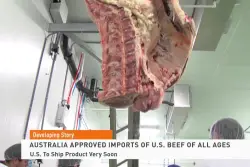
The Trump administration announces trade breakthroughs giving U.S. beef producers greater access to Australia, Japan and South Korea.

The department says it will relocate more than half of its Washington, D.C., staff to five hubs around the country, as well as consolidate or eliminate regional offices.

The U.S. Meat Export Federation is urging the Office of the U.S. Trade Representative to review pork and beef trade barriers.