
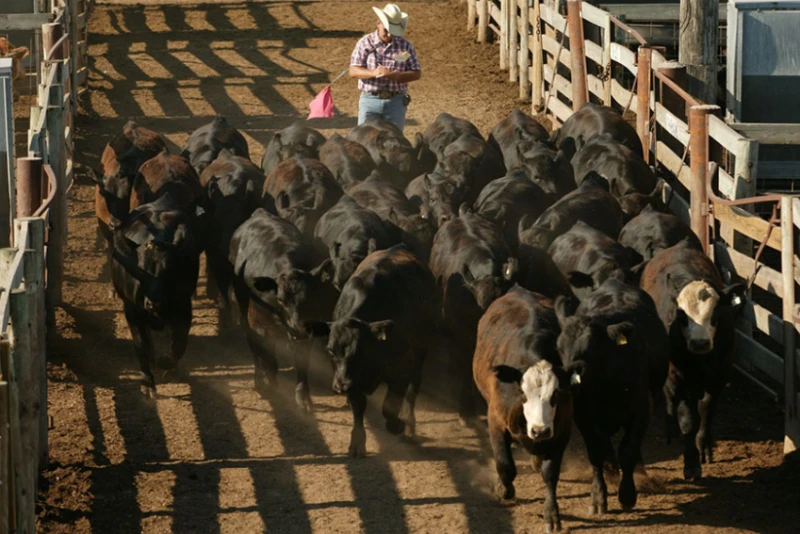
We spend years learning how to move cattle properly.
We study flight zones. We talk about pressure and release. We redesign facilities so animals can flow instead of fight. We debate crowd tubs like they’re moral issues.
Then we walk into the clinic and bark at a technician before coffee.
Ashley Nicholls, founder of Reach Agriculture Strategies, has a way of making a room laugh before he makes it uncomfortable. When speaking on low-stress handling, he starts in familiar territory: prey behavior, blind spots, comfort zones. But he doesn’t stay there.
“We understand [cattle] are prey animals,” Nicholls says. “They have blind spots. They have a flight zone. They hide pain. And their priority is survival.”
Then he pivots.
“Employees. Team members. Colleagues. They have blind spots. They have a flight zone. They hide pain. And at the end of the day, their priority is survival — it’s just workplace survival,” he says.
The room got a little bit quieter after that.
Flight Zones Aren’t Just Physical
In livestock handling, we read the pen before we apply pressure. We look for heads up, animals bunching, tension in the group. We understand what looks calm may only be a snapshot.
Nicholls reminds us this is the same with people: we may only ever get a snapshot. We don’t see what’s happening off screen — exhaustion, financial stress, family strain, imposter syndrome. Yet we respond as if the visible moment is the whole story.
Even simple gestures can make a big difference.
“Something as simple as starting with ‘good morning’ just opens a channel of communication,” he says.
In barns, we know better than to storm in loudly. The same applies for spaces with coworkers.
Communication: It’s Not the Words
Nicholls references the 55-38-7 rule of communication: 55% body language, 38% tone and pitch and 7% actual words.
“In other words, 93% of what we’re doing is completely non-verbal,” he explains.
This is an important consideration. You can ask a perfectly reasonable question and still raise the stress in a room if your arms are crossed, your voice is clipped, you’re standing too close or you’re not making eye contact. The words may be neutral, but it’s all in the delivery.
Nicholls points out cattle feel pressure long before they process anything else. Humans do, too. We scan posture, pace and tone for signals of safety.
“If I climb over the fence and I land in the pen and I’m big and loud,” he says, “All of a sudden the cattle are holding up on the backside of the pen — I probably did that.”
If the room feels tense, it’s worth assessing the energy you brought in with you.
Pressure and Release
Low-stress handling depends on timing. Apply pressure, get movement. Release pressure, allow the animal to settle. Teams are no different.
Nichols demonstrates this with a deceptively simple exercise: A group is asked to lower a lightweight pole to the ground while each person keeps two fingers supporting it. What should be easy becomes surprisingly difficult. The harder individuals try to correct it on their own touch, the higher the pole floats.
When communication is inconsistent or unclear, people push against each other instead of working together. Pressure escalates, frustration builds and the task stalls.
In livestock handling, we’d change our angle or soften the cue. In workplaces, we tend to repeat ourselves louder.
Are You Crowding the Tub?
Nicholls calls the crowd tub “the most poorly named piece of equipment in beef.”
The mistake? We crowd it.
Cattle need room to circle back toward the exit. If you pack the tub tight, they can’t move their feet. They can’t think. They lock up.
“If we take away their ability to make decisions, they also don’t have the ability to improve,” Nicholls explains.
Micromanagement works the same way.
Hover long enough and people stop taking initiative. Correct every move and they stop experimenting. Remove decision-making and growth stalls.
In livestock systems, we intentionally design spaces that allow movement. In workplaces, we sometimes build invisible walls.
Space to Mess Up
Nicholls is blunt about this part. Teams need space to mess up — and space to fix it.
Agriculture often sends mixed signals. We say we want initiative. We say we want ownership. Then we add, “Check with me first.”
He jokes about “seagull leaders” — the ones who hover overhead, swoop in to criticize or “steal your chips,” then disappear.
That approach creates anxiety, not development.
In ranching, you set the gate before you ride out. You create the conditions for success before you ask for performance. The same principle applies to onboarding staff, explaining expectations and clarifying the why.
Clarity reduces stress, autonomy builds confidence and release allows learning.
Low Stress Shouldn’t Stop at the Gate
Low-stress livestock handling changed how we think about welfare and productivity. It works because it respects biology and behavior. It acknowledges that fear blocks learning and pressure without relief creates chaos.
Humans operate under the same principles.
The uncomfortable question Nichols leaves behind is simple: if we’re willing to treat livestock with patience, intentional movement and respect for their stress thresholds, why wouldn’t we treat our teams the same way?
Low-stress handling shouldn’t stop at the gate.




