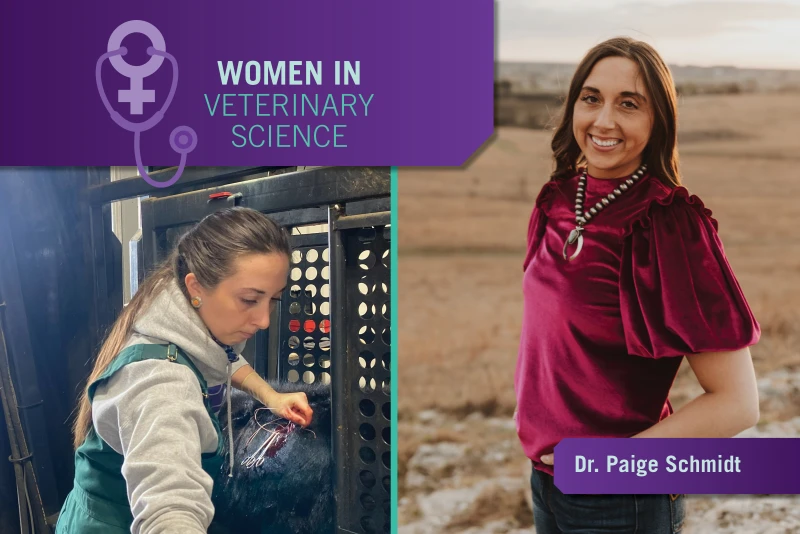
A uterine prolapse is one of the more physically demanding emergencies a cattle veterinarian can face. The organ is heavy and awkward to handle, and replacing it often requires both strength and patience.
Paige Schmidt, DVM, MS, had to reschedule our chat in favor of an emergency call from a client due to a prolapsed uterus. The producer and another rancher had already tried to push the prolapsed uterus back into place themselves, but it wasn’t working.
Instead of trying to wrestle the organ back into place alone, Schmidt used a strategy she had learned from other veterinarians.
“You take a giant garbage bag and tie it to one side of the fence,” she says. “Then I put it underneath the uterus and have the producer hold it on the other side. So they’re holding the heavy uterus, and I’m pushing it in.”
The setup makes the job easier in more ways than one.
“One, it saves me from holding it and pushing at the same time,” Schmidt says. “And two, it makes them realize how heavy it is because they’re the one holding it. Sometimes, that changes their perspective a little.”
When the procedure was finished, the rancher was surprised by how quickly it had gone.
“He told me, ‘You did that so fast. Me and my buddy were trying earlier and we couldn’t,’” Schmidt recalls. “I told him you’ve got to work smarter, not harder.”
Moments like that can shift how producers see a veterinarian.

The Quiet Tests
That kind of credibility is not always automatic for new veterinarians entering the cattle industry. Schmidt, a 2024 grad, is often challenged for perceived youth.
“Usually the first question I get is, ‘How old are you?’” Schmidt says.
It is rarely meant as an insult, but it signals producers and feedlot crews are paying close attention to her knowledge and abilities. Schmidt says she frequently experiences small tests before her clients choose to follow her guidelines. They want to know she knows how to do what she’s telling them to do.
One simple test Schmidt has experienced is identifying and pulling a sick animal from a pen while cowboys watch from horseback or along the fence line. Once she proves she can handle the work herself, the dynamic often changes quickly.
“Once they see that you can do it, they gain respect for you pretty quickly,” she says. “After that, they’ll listen to what you have to say.”
Ranch Roots & Veterinary Medicine
Long before she was earning the trust of feedlot crews, Schmidt was learning about cattle health on her family’s ranch in south-central North Dakota. Her family operates a commercial cow-calf and backgrounding operation where she developed an early curiosity about animal health.
“I wanted to know why we treated something a certain way or why a disease occurred,” she says. “The veterinarian coming to our ranch was always a big day and an important day. Looking back now, that probably had a bigger influence on me than I realized at the time.”
Even so, veterinary medicine was not always the obvious next step.
During college, Schmidt played basketball while completing her undergraduate degree. Balancing athletics and academics meant long days and late nights. As graduation approached, she was unsure whether she wanted to commit to four more years of school.
It took a nudge from the person who knew her potential best — her family’s herd veterinarian — to tip the scales.
“He really pushed me toward vet school,” Schmidt recalls. “I needed that push.”
That carried her to Kansas State University, where the academic rigors of veterinary medicine didn’t just challenge her — they fueled her. But it was a concurrent master’s degree that truly shifted her horizon. Diving into respiratory disease research, Schmidt stepped out of the familiar world of her youth and into the high-stakes environment of the feedyard.
“That experience helped immerse me into a part of the industry I hadn’t been in before,” she says. “I got to see how feedyards operate day to day and how that sector connects to cow-calf production.”
It wasn’t just about the science anymore; it was about bridging the gap between research and the field, turning complex data into tools producers could actually use.

Teaching the Feedlot
Today, Schmidt is building a consulting-focused veterinary career in Kansas, working with feedlots and cow-calf operations while also assisting a local veterinarian with ambulatory work. A central part of that work involves collaborating with the people responsible for daily cattle care and helping them implement effective health protocols.
“I can leave all the recommendations in the world, but it has to happen on the days I’m not there,” Schmidt says. “If I can teach them how to do it correctly when I’m gone, that’s a win for both of us.”
Often, that means explaining the reasoning behind common management practices.
“Sometimes people have worked in the industry their entire lives and no one has ever explained why something is done a certain way,” she says. “I love seeing the light bulb go off when someone realizes why something works the way it does. It can give them a new sense of purpose.”
Building a Career — and a Life
For Schmidt, the ultimate “dream job” isn’t a destination — it’s a rhythm. She is focused on scaling her consulting practice, moving toward a model built on consistency and long-term client relationships. That being said, as she expands her footprint in the beef industry, she remains protective of her time.
“I want to build a career where I take care of my clients, but also have time for family and personal things,” she explains.
It’s a practical approach to a demanding profession. Just as she managed that prolapse call with efficiency and precision, she’s applying that same logic to her career trajectory. Success, she’s realized, doesn’t come from burnout; it comes from the cattleman’s oldest rule: Work smarter, not harder.