
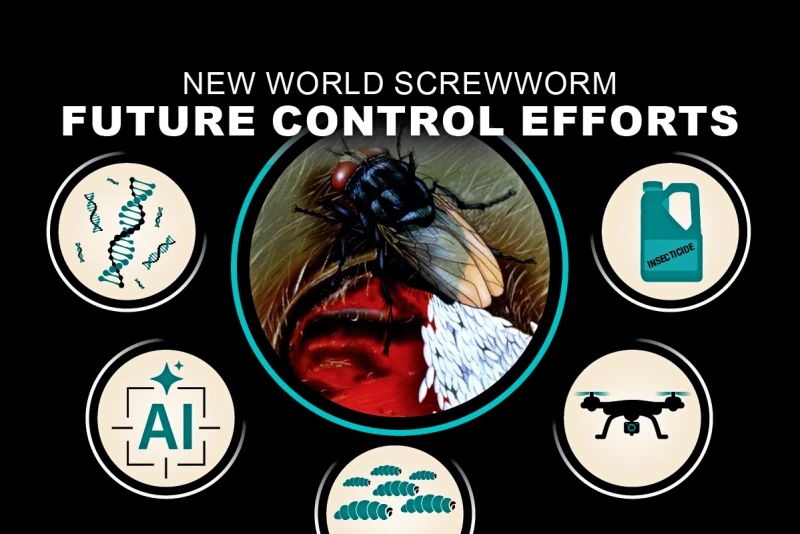
For nearly 70 years, the Sterile Insect Technique (SIT) has been one of animal agriculture’s greatest success stories, protecting livestock across North and Central America by releasing millions of sterile screwworm flies.
That proven strategy is once again being put to the test. Since the first domestic case was confirmed in early June, 32 cases of New World screwworm have been reported in the United States, underscoring the need for both an aggressive response today and better tools for the future.
While federal and state officials focus on containing the current outbreak, researchers are asking a different question: How can the next generation of screwworm control be made faster, more efficient and better equipped for future incursions?
Today’s Sterile Insect Technique
- Currently produces approximately 100 million sterile flies each week
- A newly opened production facility in Mexico is expected to double that capacity by the end of 2026
- Relies on mass rearing and radiation sterilization
- Releases both sterile males and sterile females
- Has served as the foundation of New World screwworm control for decades
Through the USDA’s New World Screwworm Grand Challenge, researchers from academia, industry and government are tackling different bottlenecks in screwworm control, from improving sterile flies and scaling production to developing new ways to eliminate screwworm larvae.
Together, these projects offer a glimpse of what the next generation of screwworm control could look like.
Improved Sterile Male
SIT succeeds because released sterile males compete with wild males to mate with females. Those matings produce no offspring, gradually driving the wild population downward.
One limitation of the current production system is that it still rears both male and female flies. Although released females are sterilized and cannot reproduce, they do not contribute to suppressing the wild population. They also consume valuable space, diet and production capacity that could otherwise be devoted to producing more males.
Improving the quality and competitiveness of released sterile males is the focus of Max Scott and his team at North Carolina State University. Building on more than a decade of research, including development of the NovoFly strain, Scott’s latest project explores refined female-lethal systems, CRISPR-based sterility and other approaches to produce healthier, more competitive males.
“The females don’t consume diet. So you can effectively double your male production from the plant,” Scott explains.
Producing more males is only part of the equation. They must also successfully compete with wild males after release.
“It’s really a numbers game. You’ve got to outnumber the fertile males out there so that the females will mate with a sterile male,” he says.
Scott’s team is also investigating whether CRISPR-based sterility could reduce or replace the need for radiation. Because radiation can reduce insect fitness, a genetic approach may produce stronger, more competitive sterile males while maintaining the effectiveness of the SIT program.
“We’re building on what we’ve done before, hopefully have different conditional systems producing sterile males and then using CRISPR as an approach to produce sterile males,” Scott says.

Scaling Sterile Fly Production
Even better sterile males must be produced at the scale required for eradication programs.
Bryan Witherbee of Agragene is collaborating on two Grand Challenge projects designed to make male-only production faster, more efficient and easier to scale.
“I think it’s important that the USDA is casting a really wide net around technologies to try to knock out this pest before it is allowed to get a strong hold here in the U.S.,” Witherbee says.
One collaboration combines Agragene’s artificial intelligence-based imaging technology with dietary approaches that may create subtle physical differences between male and female screwworms. Machine learning algorithms may be able to recognize differences that are nearly impossible for people to detect, allowing automated sex sorting during production.
“We don’t know what the parameters are in terms of what the algorithm is picking ... but it does a really good job separating out males and females that, to the eye, look very similar,” Witherbee explains.
A second project applies RNA interference (RNAi) technology to interfere with the development of one sex, enriching populations for males before they reach production. Like Scott’s work, the goal is to maximize the number of sterile males available for release.
Unlike many research initiatives that unfold over several years, the Grand Challenge is designed to accelerate promising ideas.
“This isn’t a project where you’re going to spend four to five years trying to work through everything. You’re hoping to move this very quickly within one year from concept all the way to product,” Witherbee says.
Rather than inventing entirely new tools, the team is adapting technologies already proven in other insect species for New World screwworm.
Expanded Treatment Toolbox
While many researchers are focused on improving SIT and screwworm surveillance, another team is exploring an entirely different way to attack screwworm.
Instead of changing the fly itself, Lee Haines and Álvaro Acosta-Serrano from the University of Notre Dame are investigating whether they can exploit one of its greatest biological vulnerabilities: Its dependence on a protein-rich diet like flesh and blood.
Their projects center on nitisinone, an FDA-approved drug currently used to treat rare human metabolic disorders, tyrosinaemia type 1 and alkaptonuria. Their previous work spanning more than ten years on several insect species, alongside international collaborators, showed the drug disrupts tyrosine metabolism, which is a digestion pathway essential for blood-feeding insects after they consume blood. The team’s new research will determine whether the same biology can be exploited to kill screwworms.
“Unlike your typical insecticide that would wipe out fireflies, butterflies and countless other insects along with the target species you want to eradicate, nitisinone zeroes in exclusively on blood-feeding insects and leaves everything else alone,” Haines explains.
In the early stages of research, the team is exploring several potential applications. One possibility is treating screwworm-infested animals, so larvae die while feeding. Another is using the drug during livestock quarantine to protect imported animals while they are being monitored. Researchers also discussed topical wound treatments that could prevent larvae from becoming established in fresh wounds.
Longer term, Haines says the drug could potentially be incorporated into combination therapies alongside existing products such as ivermectin to help reduce selection pressure for drug and insecticide resistance. However, she emphasizes those ideas remain speculative until the team’s proof-of-concept studies are complete.
Before any veterinary application becomes possible, however, researchers will need to evaluate dosing, residues in meat and milk, delivery methods and cost. The team also plans to use disease modeling to determine how the drug could be deployed most effectively under field conditions.
“We will complement these studies with modeling,” Acosta-Serrano says. “You likely don’t need to treat the whole population, but just strategically treat some of them.”
Rather than replacing existing control methods, the researchers see nitisinone as a precise and targeted addition to the screwworm control arsenal. Its power lies in exploiting a metabolic vulnerability unique to blood-feeding insects, turning the fly’s own biology against it while leaving the broader ecosystem unharmed.
The Next Generation
No single technology is likely to solve New World screwworm on its own. Instead, these projects illustrate how researchers are strengthening multiple parts of the control strategy simultaneously, from producing fitter sterile males and improving production efficiency to expanding treatment options.
Haines believes the diversity of projects funded through the USDA Grand Challenge may ultimately prove to be one of its greatest strengths.
“It’s really encouraging to see the diversity. You have drones, you have biochemistry, you have new RNAi technology. It’s so diverse. Let’s hope that if 5% of those come through with something, that’s more than we had before,” she says.
Together, the projects represent more than three individual research grants. They demonstrate how advances in genetics, artificial intelligence, RNA biology and pharmaceutical science are converging to strengthen one of animal agriculture’s most successful pest control programs.
SIT transformed screwworm control during the last century. The next generation of innovation is not designed to replace that foundation, but to build upon it, making future control efforts more efficient, more adaptable and better prepared for the future.




