

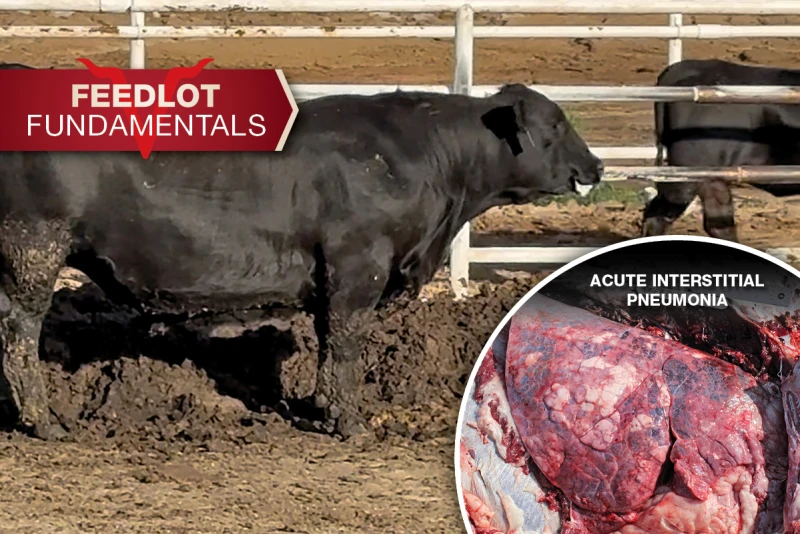
Acute (or atypical) interstitial pneumonia — often shortened to AIP — is one of the most frustrating respiratory problems feedlots face. It doesn’t hit every lot, every pen or even very many head. But when it does show up, it usually strikes late in the feeding period — often after 100 days on feed — in high-performing cattle and can carry a case fatality rate of 70% to 100%.
“You can have a heifer that looks fine in the morning and is in severe respiratory distress by the hot afternoon,” says Dr. Paige Schmidt. “By the time we see it in the feeding period, a lot of our economic resources on that animal are already invested.”
Schmidt is a mobile- practice veterinarian in Turon, Kan., where she is building a consulting career in the Kansas/Nebraska region. She has been part of research efforts to better understand AIP in feedlot cattle. She says the industry is still searching for clear answers — but there are patterns and practical lessons producers can use today.
Here are seven facts beef producers should know about AIP:
Fact 1: AIP Comes On Fast and Looks Like a Severe Respiratory Wreck
AIP is a respiratory disease with an acute onset of clinical signs. Cattle can appear normal in the morning and be in serious trouble by evening.
“AIP is a respiratory disease that has an onset just like its name,” Schmidt describes. “It comes on very acutely. The animal can be normal one morning, and then later that evening can show severe respiratory signs, such as typical respiratory distress, open-mouth breathing. They can have froth from their mouth — they’ll extend their neck out trying to better be able to breathe.”
Common visible signs include:
- Open-mouth breathing.
- Froth or foam from the mouth.
- Wide-based stance to open the chest.
- Extended neck.
- Grunting or obvious discomfort when breathing.
Schmidt notes some earlier, subtler signs — like breathing more from the flank or light grunting — may appear before cattle become obviously distressed.
Fact 2: Very Few Cattle Get AIP, but Most of Them Die
One of the most difficult aspects of AIP is the mismatch between its low morbidity — percentage of animals that get sick — and very high-case fatality — percentage of those sick animals that die.
“One of the research studies I did with the Beef Cattle Institute,” Schmidt explains, “we found AIP mortality was 0.18%, so every two in 1,000 head of cattle on feed were affected. Although AIP impacts a relatively small proportion of all cattle, this syndrome represented nearly 10% of the mortality cases when all causes of death are considered. Of those cases identified, 70% to 100% lead to death even after treatment.”
In other words, it doesn’t hit many cattle — but when it does, the odds are not in their favor.
Fact 3: It Strikes Late in the Feeding Period, When the Stakes are Highest
AIP is typically a “late-game” disease. Schmidt says cases usually occur in cattle that have been on feed more than 100 days, often within 30 days of shipping.
“We usually see it in cattle that are longer days on feed, so cattle over 100 days on feed,” she explains. “That’s when our economic resources are exhausted. They’ve gone through 180 days of feeding, they’ve had extensive labor costs and we’re seeing this close to shipping, which makes it so devastating.”
To put the dollars in perspective: “I looked at the board today, and one of those finished heifers is worth about $4,000. And that’s just her value — that’s not even all the input costs that went into her,” Schmidt explains in early June.
When an AIP case shows up at that stage, you’re not just losing an animal — you’re losing months of feed, labor and opportunity.
Fact 4: Summer, Heifers and Long-Fed Cattle are Common Threads — But the Cause is Still Unclear
Research hasn’t pinned down a single cause of AIP. Instead, there’s a short list of suspects that seem to show up repeatedly.
“Heat may play a factor,” Schmidt says. “It occurs more frequently in the summer months, potentially dust — dust particles irritating the airways — or some type of metabolic disturbance.”
One consistent finding seems to be heifers appear to be at higher risk than steers.
“There’s a higher incidence in heifers than there is in steers,” she explains. “That doesn’t mean steers can’t get it; we just see it in heifers a little more frequently.”
Even so, Schmidt cautions against looking for a single silver-bullet explanation.
“We don’t know what causes it, and there’s a lot of different options,” she stresses. “It’s likely something that’s multifactorial, a little bit of everything, but it’s really hard to do a clinical trial and research because we’re seeing it so sporadically.”

Fact 5: AIP Lungs Don’t Look Like Typical BRD on Necropsy
Post-mortem, AIP has a distinct lung pattern that sets it apart from classic bronchopneumonia.
Schmidt explains, post-mortem, their lungs don’t deflate after the animal dies.
“There is either fluid or air trapped within the interstitium of their lungs and they get multiple — we call it a checkerboard appearance — they get multiple colorations throughout all the lung lobes,” she says.
That’s different from typical BRD, which tends to affect the front-bottom portions of the lung.
“It’s not just affecting your cranial-ventral lung lobes that we see most commonly with BRD, because bacteria is heavy and it sinks to the bottom,” she explains. “When you cut into an AIP affected lung, you can see edema, fluid or air — emphysema — trapped within the interstitium.”
Adding to the complexity, necropsies sometimes reveal both bronchopneumonia and interstitial pneumonia in the same animal.
Fact 6: Diagnosis is Tricky and Necropsies Matter
Clinically, AIP can look a lot like other respiratory problems or even heart failure. That makes accurate, post-mortem diagnosis critical.
“Our diagnosis of it isn’t super accurate, because it looks like heart failure, it looks like bronchopneumonia,” she says. “We have this bias that [a] summer black-hided heifer with acute respiratory distress has to be AIP. It doesn’t have to be — that’s just our easy diagnosis.”
Schmidt says more yards are turning to necropsies, especially on cattle that die in the pen without a treatment history.
“A lot of feedlots will necropsy cattle that were pen deads, meaning they died in their home pen and had no treatment record,” she says.
Schmidt suggests necropsying all deaths would be a good start to diagnose and really track what disease processes are going on.
Fact 7: Treatment is Mostly Supportive — Pen-Rider Vigilance is the Best Tool
There is no labeled, guaranteed cure for AIP. Current treatment strategies focus on supportive care and, importantly, how early cattle are pulled.
“If affected cattle are identified early enough, supportive therapy with corticosteroids, nonsteroidal anti-inflammatory drugs (NSAIDs), antihistamines, or diuretics may improve outcomes. These treatments are considered supportive because the underlying issue appears to be an exaggerated immune response driving the pulmonary pathology.” Schmidt explains. “So, we’re trying to minimize the response of the immune system. A lot of operations also give an antibiotic — just so we cover our bases in case there is an infection.”
Her core management message to feedlots is straightforward: “Sometimes our pen riders and people can get complacent — because [cattle have] been there for a long time — but really getting all those cattle up, looking at every single one of them, especially in the summer months as they get fatter into their harvest state, they need more attention too. Some of them are treatable.”
For now, Schmidt sees feedlot AIP as a feedlot-specific problem, not something caused by prior management — though she stresses good basic health practices upstream still matter.
With no vaccine or silver bullet to cure AIP, Schmidt summarizes watching late-day cattle — especially summer heifers — for small changes in breathing and attitude may be the best practical defense yards have today.




