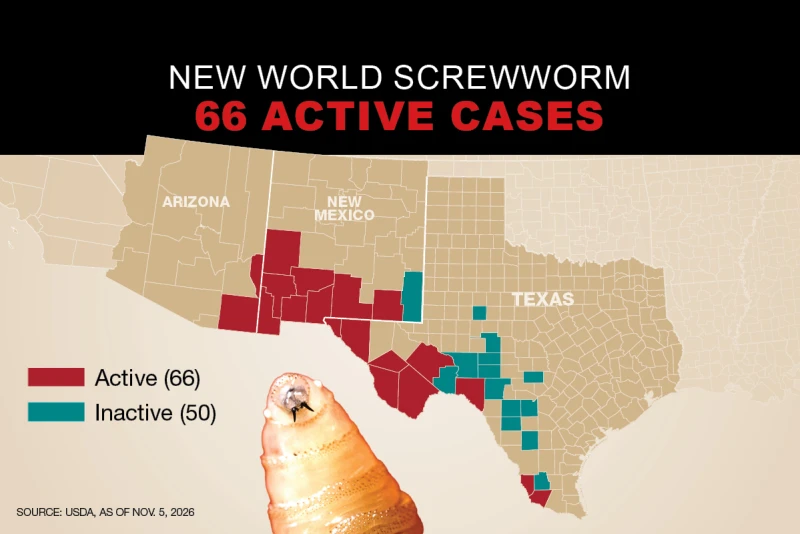
USDA is maintaining a 24/7 response to New World screwworm (NWS) as activity increases in parts of the Southwest. USDA Undersecretary for Marketing and Regulatory Programs Dudley Hoskins cites warm, wet conditions in New Mexico and Arizona as one factor supporting the fly population and stresses continued surveillance, trapping and prompt reporting are central to the response.
“When you look at the environmental factors on the ground, especially in New Mexico and Arizona, the amount of rainfall and moisture that they have in those environments right now” and the temperatures have created favorable conditions, Hoskins explains. “Those two things, hot and wet, are things that the screwworm fly love.”
State agricultural leaders on the front lines agree. Dr. Bud Dinges, Texas Animal Health Commission (TAHC) executive director and Texas state veterinarian, says weather conditions are playing a direct role in recent detections.
“There are many factors that could play into the uptick in cases as of late. Namely, weather conditions are certainly a factor. Increased rainfall and moisture, combined with lower temperatures, are conducive for NWS activity,” Dinges explains. “West Texas is very green and wet, ideal NWS fly conditions.”
In Arizona, Department of Agriculture Director Paul Brierley echoes that assessment, pointing to abnormal precipitation that created lush forage across the desert landscape.
“I’m pretty sure that it’s the fact that we’ve had record rainfall and now new grass, and they love the warm, moist environment. So I’m pretty sure that’s what has done it,” Brierley says. “It’s all the Southwest states where it’s hitting, and we’ve had just record rain and flooding, and that leads to grass.”
While Hoskins notes federal officials are not counting on an early hard freeze to materially halt fly movement, Brierley says regional producers are watching the thermometer closely. In southeastern Arizona, where recent cases emerged, nighttime temperatures typically plunge into freezing territory after Halloween — a seasonal shift state officials hope will deliver temporary relief on the ground.
As of Nov. 5, there are 66 active NWS cases in the U.S. Since the first detection in June, there have been 116 confirmed cases across Texas, New Mexico and Arizona. Monthly figures underscore the sharp autumn escalation: only three cases were recorded in September, compared to 36 in October and already 30 through the first five days of November. While the majority of detections involve livestock, confirmed cases have spanned multiple species, including cattle, horses, sheep, goats, dogs, a domestic cat, two elk and a chicken.
According to USDA APHIS, since June 3, USDA has evaluated 1,066 suspect samples nationwide, including 558 from Texas, 35 from New Mexico and 15 from Arizona, and 458 from other states and surveillance channels. Officials emphasize that producer reports trigger swift field intervention. To learn more or submit a suspect report, visit Screwworm.gov.
📊Number of the Day: 86,487 Since July 3, 2025, more than 86,487 suspect flies have been submitted from traps, with only 5 wild New World screwworm flies detected. Supporting this effort: 🪰 Over 300 NWS-specific fly traps and bait locations 🔬 More than 7,000 insect traps in border states Surveillance works because of strong collaboration among USDA, state officials, industry partners, and producers. 🤝
— New World Screwworm Rapid Response (@Screwworm_RR) November 5, 2026
Since expanded border surveillance began, more than 86,487 suspect flies have been submitted from traps, with only six confirmed as wild NWS flies. The trapping grid includes more than 300 NWS-specific bait stations and more than 7,000 general insect traps across border states.
Ramping Up Sterile Fly Production
While containment measures limit regional spread, state and federal leaders agree long-term eradication hinges on the sterile insect technique (SIT).
“The message, the posture, the commitment to mission. None of that is wavered. None of that has changed. None of it will until we get our max production capacity online and operational,” Hoskins stresses. “Until then, we will be in a 24/7 response posture.”
In Texas, Dinges identifies sterile fly supply as the single most critical factor in subduing the outbreak.
“The bottom line is we need more sterile flies to help end the lifecycles and reduce the fly population,” Dinges says. “As we continue to see cases in Mexico and as cases continue to pop up in northern Mexican states, that truth remains clear.”
Relief infrastructure is moving forward. Brierley reveals that Arizona is collaborating with USDA to build a new, modular sterile fly dispersal facility near Douglas. Once operational, the hub will distribute sterile flies across the southern border corridor from San Diego to El Paso.
Brierley also points to Arizona’s first confirmed case on Oct. 28 as evidence federal and international partnerships can react immediately. Within 24 hours of confirmation, an aerial dispersal aircraft dispatched from the Hermosillo, Mexico, dispersal facility was flying grid patterns over the Arizona infested zone, releasing sterile flies to disrupt the local mating cycle.
“Seeing that flight come on the very next day really to me showed the system works,” Brierley says. “You report the problem, we implement movement restrictions, and flies get dispersed.”

Wildlife Surveillance: Hunters Urged to Stay Alert
USDA Animal and Plant Health Inspection Service (APHIS) Wildlife Services personnel have observed a total of 169,238 animals and investigated 42 animals with suspicious wounds and behaviors. Drones, trail cameras and ground teams form a landscape-level detection network along southern border corridors.
In Arizona, Brierley notes the state is working with USDA to develop an expanded wildlife observation network that repurposes border-monitoring technology and infrastructure.
“We hope that Arizona is going to be a model for how you monitor wildlife,” Brierley says, adding that multi-agency planning meetings are underway this month to coordinate deployment.
With fall hunting seasons underway across Texas, New Mexico and the broader Southwest, thousands of sportsmen and ranchers are in pastures and brush country daily. USDA and state wildlife agencies are urging anyone handling livestock or wild game to inspect animals carefully.
HUNTERS: Be sure to check your harvest carefully this deer season for signs of New World screwworm. 📽️ Watch how to do a quick exam at https://t.co/elEuaOEfOd If you suspect infestation, contact your local wildlife biologist immediately 👉 https://t.co/t8WeXGu8jp https://t.co/R9JJ3AeQak
— Texas Parks & Wildlife (@TPWDnews) November 5, 2026
Officials Defend Port Protocols
As some producers question whether the border reopening is linked to the rise in cases, federal and state officials defend current import protocols.
Hoskins stresses USDA maintains high confidence in inspection and treatment protocols at legal crossing points, including Douglas, Ariz., and Santa Teresa and Columbus, N.M. Inspectors have not detected or cleared an infested animal through those ports, Hoskins says, emphasizing that legal import channels are heavily fortified.
Brierley, whose department oversees state-level checks at Douglas — the first port to reopen — directly counters rumors that imported cattle are introducing the fly.
“They do raise that question. It’s a natural... jump to that,” Brierley says of producer concerns. “But I’ve been heavily involved with the port opening. The amount of new protocols in place, both by USDA and by us, we believe those cattle are the most inspected, safest cattle anywhere in the world, and the system’s working.”
Brierley outlines a rigorous, multi-layered gauntlet: cattle entering from Sonora, Mexico, undergo dipping treatments, a holding period, and pre-entry examinations by USDA personnel, followed by sweeps with screwworm-detection scent dogs. Upon crossing into Arizona, shipments require mandatory electronic identification (EID) tags for full traceability, a physical Arizona state veterinary inspection, and a final paperwork verification by specialized state inspectors before release.
When inspectors recently flagged a single animal displaying non-screwworm mouth lesions out of a 1,700-head run, the port halted movements for two days to run exhaustive laboratory tests. “We know the system works,” Brierley emphasizes. “Don’t believe they’re coming across on the cattle.”
Equine shipments resumed through Santa Teresa on Oct. 26 under individual hand-spray protocols and mandatory seven-day quarantines to guard against both screwworm and Venezuelan equine encephalitis, while the Nogales, Ariz., crossing is scheduled to reopen Nov. 30 under the same rigid playbook.
Officials acknowledge other vectors are far harder to police, including migrating wildlife, feral swine and illicit cross-border animal movement. Hoskins says USDA is actively partnering with Mexican authorities and state veterinarians to plug potential gaps.
Managing Infested Zones Without Herd Depopulation
Hoskins reminds producers and consumers NWS is not a food-safety risk. It is an external parasitic infestation rather than a contagious systemic pathogen.
“It’s obviously a parasitic concern,” Hoskins explains. “It’s a pest, but it is not a disease. It’s not a pathogen. It’s not something where you have to depopulate a herd.”
Producers also have far more therapeutic options than during previous outbreaks. The Food and Drug Administration (FDA) has issued 16 Emergency Use Authorizations (EUAs) and granted three conditional approvals for veterinary drugs targeting screwworm infestations.
At the state level, both Texas and Arizona are balancing rigorous containment with producer communication to dispel fears that reporting infestations triggers herd seizures.
“Texas producers, industry, veterinarians and government responders have all worked tirelessly to establish zones, limit movements to only uninfested animals out of these zones, and educate all animal owners on how to prevent this pest,” Dinges says. “The Texas Animal Health Commission remains committed to shifting our response in real time to optimize stopping the spread, reducing impacts, and responding efficiently.”
In Arizona, Brierley says the department is hosting community town halls drawing 100 to 200 attendees each to explain quarantine rules.
“I know there’s a hesitancy to report when they have a case, thinking, ‘Oh, I’m going to get quarantined and locked down.’ It’s actually not the case,” Brierley explains. “What the case is, is you get help trying to get rid of the fly. It basically means your animals have to get inspected and have a certificate of veterinary inspection before they leave the infested zone, just to make sure it’s not being spread.”
Response Resilient Despite Flare-Up
Hoskins insists the current flare-up does not signal a failing eradication strategy, pointing out that sporadic infestations persisted for years after the U.S. declared screwworm eradicated in 1966 before sustained aerial releases cleared the pest.
“We’ve been here before. We beat it before. We’ll beat it again,” Hoskins says. “Right now, the flare-up and the infestations in different areas is a concern, but in no way reflective of the wavering or the work that’s happening on the ground.”
Dinges and Brierley urge animal owners, hunters and veterinarians to monitor livestock and wildlife closely and report any suspected cases immediately.
“We continue to ask that animal owners, hunters, veterinarians and anyone else that can puts eyes on animals, reports suspicions of NWS immediately, and avoids moving suspected or known infested animals,” Dinges concludes.
Your Next Reads:
- The Smell You’ll Never Forget: A Calf Infested with New World Screwworm
- Operation Sterile Fly: The Best Shot to Stop New World Screwworm
- Third Gate to Open Oct. 26: Columbus, N.M., Port Set to Resume Cattle Trade
- Inside Day One at Douglas: How USDA and Arizona Will Clear Cattle and Block Screwworm at the Border